Cybersecurity is a buzzword due to the growth of the cyber landscape. However, there is a need for understanding the subject in real terms for cyber safety. The threats and data breaches are not only affecting individuals but also organizations. The concept of the 5 Cs of cybersecurity for your business safety has emerged due to this.
Cybersecurity has become a crucial priority for businesses of all sizes. With the rise in cyberattacks and data breaches, safeguarding sensitive information and digital assets has never been more critical. Not knowing the digital landscape of cybersecurity may become detrimental to your business, as it could severely impact your business safety and ultimately customers’ trust. Businesses need to adopt a robust cybersecurity framework to avoid cyber theft as hackers always look for exploiting the weak cyber practices.
To structure an effective cybersecurity strategy, you need to focus on the 5 C’s of cybersecurity. Understanding the 5 C’s of cybersecurity is vital to safeguarding your systems, data, information, and business operations against cyber threats. The 5 Cs or key functional areas: change, cost, compliance, coverage, and continuity work coherently to build a strong base for cybersecurity, data breach avoidance. This framework provides businesses with a comprehensive toolkit to assess, improve, and elevate their cybersecurity strategies. I
In this article, we are going to dissect each of the 5 Cs, enabling you to get the underlying necessity of these Cs for your business.
1. Change
Change is inevitable in this world. As technology evolves, the same way hackers also find novel ways to hack systems and commit a data breach. This process continuously runs side by side as cyber threats are consistently changing. As a business unit protecting your systems, data, and other digital assets from cyber threats, you need to be proactive. Embracing change is vital for you to overcome potential risks. You need to stay informed about the latest threat intelligence, navigate the evolving regulatory landscape, and harness emerging technologies to lead your cybersecurity efforts.
To stay ahead of new threats, you need to be flexible enough to make informed decisions about continuous systems security patches, Windows updates, and update your security procedures, systems, and technologies on a regular basis. Change is the key if you want to keep abreast of the latest developing threats and take ultimate action against them to avoid business disruption and reputational loss.
2. Compliance
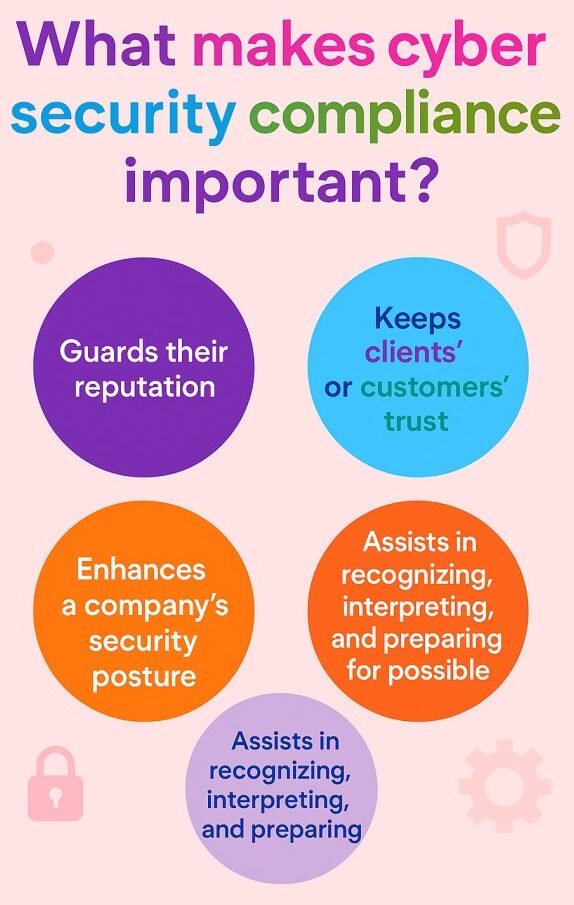
Running your company or managing your business operations, you would be well aware of the compliance concept, which is actually acting according to certain defined rules and regulations. In technical terms, how your organization adheres to cybersecurity systems and practices according to relevant data protection laws, industry regulations, and standards. Compliance helps you to avoid and mitigate any legal complications as well as safeguard your business operations from any possible threats.
It is the compliance part of the 5 Cs of cybersecurity framework that ensures following security best practices and enforces relevant technical controls to protect your information and digital assets.
A strong IT compliance posture is crucial to facing this intensifying cyber and regulatory hurdle. Usual compliance standards, ISO 27001 and NIST, introduce you to details about the controls to safeguard your systems and data from potential threats and vulnerabilities you may encounter.
These regulations are more important for small businesses as they provide a comprehensive set of standard rules and regulatory practical steps for cybersecurity.
3. Cost
Cost is a major consideration for any business. While dealing with cybersecurity, you need to have an effective way of managing your costs. No doubt, budgetary constraints are there, but you can’t ignore the importance of cybersecurity for your business operations. It is of paramount importance to note that some costs incurred on your cybersecurity and digital safety would always be very less than what you would have to bear in case you don’t have safety measures in place and a data breach happens. Be mindful that the cost of cybersecurity is an investment, not an expense.
While keeping a close check on your costs, consistently monitoring and adjusting security investments in response to the changing threat landscape is quite essential to avoid a cyber breach.
4. Continuity
As a business unit, you don’t have a cushion to stop your operations under any circumstances, as it affects your goals and ultimately your customer base. Continuity is the key. Security isn’t solely about preventing attacks rather it is about how your business operations get going and running smoothly, even when things go wrong. So continuity starts here. The prerequisites associated with continuity are your Backup plans, disaster recovery plans, and business continuity processes in case your company is targeted by cybercriminals. All these activities and processes ensure that your work doesn’t come to an abrupt halt and that you become clueless.
5. Coverage
The Cybersecurity policy needs to be comprehensive. It should include and cover every aspect pertaining to your security, like your devices, people, technology, and applications. Apart from internal systems, it should also cover cloud services and third-party suppliers. Coverage means that you are patching everything, not just installing antivirus. It is about addressing employees’ concerns and training them on safe security practices, patching all systems, and even mobile devices. For Work-from-home employees, defining policies and implementing dot1x protocols can help restrict access to open Wi-Fi and ensure VPN security assurance.
Final thoughts
Cybersecurity has become essential for companies that handle sensitive client data and depend on digital security. By comprehending and enforcing the 5 C’s of Cybersecurity, it is not just about ticking a checklist. Instead, it’s about constructing a mentality that supports protecting your digital world. Remember, cybersecurity is not like a one-size-fits-all fix—it’s a continuous commitment.