


Introduction
The security of the PC running on Windows can afford to be free of charge. Most users believe that they can only stay safe using paid programs. But it is Windows that has incorporated effective, free security mechanisms by Microsoft.
Maintaining the safety of your PC without spending even a rupee is also possible in case you understand how to use them correctly. This tutorial gives realistic and workable measures to secure your windows computer using native tools together with good practice.
Good Practices to protect your Windows PC
Windows Defender Basic Protection

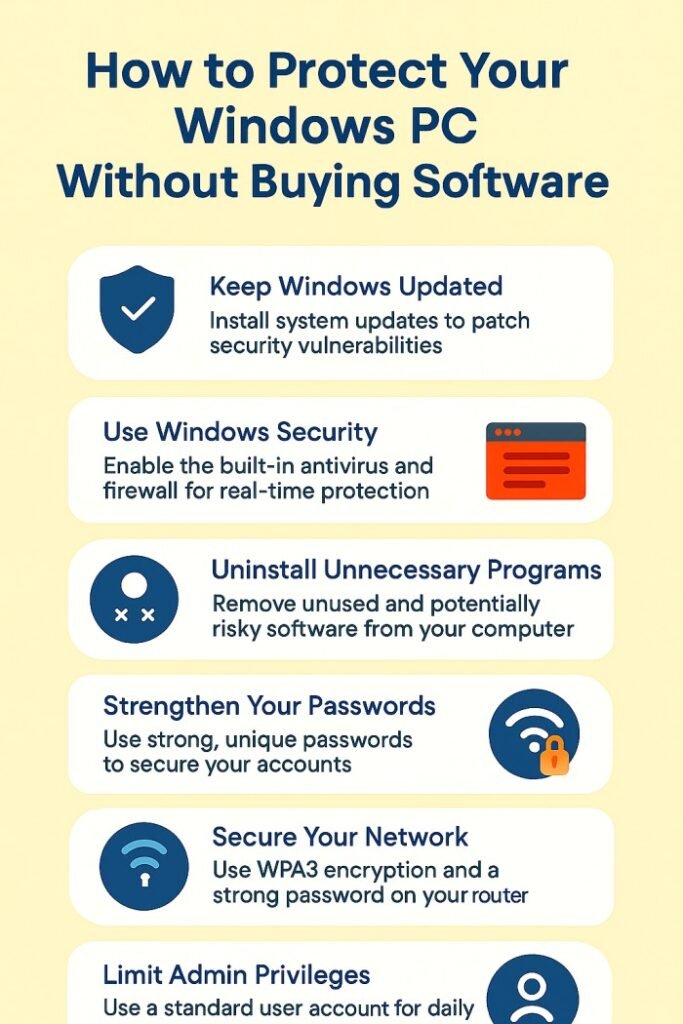
You already have Windows Defender installed on your system; in fact, Windows Defender is now known as Microsoft Defender Antivirus. It operates in the system, managing files, applications, and downloads. It assists in the identification of viruses, malware, and ransomware. Defender is constantly updated and provides time-based security.
This tool is now very good at independent antivirus testing, unlike its older versions. Turning to it is an excellent initial measure to cushion your Windows computer. You should ensure that it has been switched on and it is not disabled by any third-party applications.
Keep Your System Updated tabs
A secret protection is system up-dates. Whenever you turn off windows updates, you put back vital security updates. Problems with the obsolete systems are targeted by hackers. This is the reason that automatic updates cannot be overstressed.
Windows transmits frequent patches to seal vulnerabilities. These upgrades also enhance performance as well as software compatibility. To safeguard your Windows PC, go to settings and make sure you visit the section called Windows Update. Plan the time when you do the update to keep your PC safe without much interference.
Enable and enable Windows Firewall

Windows has an inbuilt firewall that monitors the traffic in your PC. It cleans information that is passing between your computer and the internet. A firewall prevents any suspect data linkage and assists in avoiding remote access. Access the Control Panel and make sure that Windows Firewall is enabled. It is also possible to have rules to certain apps.
In case you are utilizing an open network, enhance the degree of protection. This gives you one more layer to secure your Windows PC and you do not have to spend your hard-earned money in buying some external firewalls.
Smart and Safe Browsing Behavior Use
Internet activity brings a lot of threats. The typical traps involve unsafe sites, fake downloads, and download links. Utilize Microsoft Edge with built-in defense such as Smart Screen. This helps to caution against a dangerous website. Do not click on unrecognized links, particularly in emails. Never rewrite URLs, regardless of where you want to enter your details. You make significant actions to secure your Windows computer when you alter the way your browser works.
Establish Powerful User Account Controls Settings
User Account Control (UAC) warns you about the attempts of apps to change something. It disables any unauthorized installations and settings. Go to the control panel and set your UAC settings. Maintaining it at the suggested level assists in preventing the occurrence of dangerous activities.
It even alerts you to the need of administrative permission. Your Windows PC is also at great risk to internal threats, as UAC is an essential component of a secure system, and its proper utilization can severely guard your Windows PC.

Make a Different Standard User Account
It can be dangerous to use your PC with an administrator account on a daily basis. In the case that the malware finds its way in, it might change the system-wide capabilities. Rather, make a standard user account which you will use daily.
Admin account should be used in software installation or changing settings. This lowers the possibility of breakage. A restricted account will also guard your Windows computer since it will prevent any malicious software could execute.
Protect Your Home WIFI
Much as your PC may be safe, a vulnerable or open wireless local area network could expose you. Replace the router password that is set automatically at first and use the WPA3 or WPA2 encryption. Restrict access to the devices connected to your network.
Have the router firmware upgraded. In case one gets access to your network, they can attack your PC. Therefore, securing the use of your internet in another roundabout manner is guarding your Windows PC against distant threats.
Disableness: Unnecessary Services and Features
Windows has numerous background services. Not all of them are necessary and may be employed in order to abuse your system. Deactivate such options as Remote Desktop in case you never use them. Place Bluetooth off when not in use.
Check the startup apps and turn off what you do not need. When you streamline your system, you will have less exposure and fewer access points to your Windows PC.
Back up Your Valuable Files on a Regular Basis
Security is not all about prevention, but it is also about recovery. Backups are necessary in case of hard disk failure or ransomware. Automated backup can be made possible by utilizing the File History or OneDrive. These are free tools found in Windows.
Establish routines so that they do not have to be remembered all the time. Backups do not deter the occurrence of attacks, but help to provide a safeguard to your Windows PC against the impact of the loss of data.
Do not use Unknown USB devices
Connecting USBs that are unfamiliar presents a high risk of security. There is malware in some USBs that automatically runs. Windows can also attempt to open the files instantly to be more exposed. It can be avoided by disabling auto-run in the settings.
Only trusted USBs are to be used and scanned first using the Defender. Being cautious when using devices keeps you safe on your Windows PC in the common situations that one usually does not observe.
Lock Your PC On Not being used
Whenever leaving your desk, make sure you lock your screen. The fastest method is by pressing the keys Win + L. An Unlocked PC is an open invitation to tampering. This is even greater in places of worship. Adjust the auto-screen lock on your screen to lock after leaving idle for a short time. This kind of simple move saves your Windows PC by restricting the movement to your machine.
Check the Action using Task Manager
System performance would help you identify the suspicious behavior. Check the processes that run in the background by opening Task Manager. In case you see unfamiliar programs that use excessive amounts of resources, it is an indication of an infection.
It is possible to terminate tasks and then find the source. Such a manual control is not invulnerable, but it can help bring an additional pair of eyes to your Windows computer to guard it against evil lurking in plain view.
Learn About the Emerging Threats
The nature of cyber threats varies with time. There are new methods, and the old methods become new. Your long-term protection is to make sure you stay informed. Read blogs or discussions by well-known technology websites.
Get to know about phishing, trojan, and zero-day attacks. Awareness allows you to detect the symptoms early enough. The better you know about the digital threats, the more efficiently you will be able to secure your Windows PC with no need of any costly products.
Conclusion
Software is not the only investment you have to make in order to keep your system safe. Windows has potent features installed in it by Microsoft. Together with the smart user behavior, these tools protect all levels.
Antivirus, firewall, system update, and account control all of play an important part. Together, they form a strong defense line. With the wisdom and regularity, there are many ways to secure your Windows computer without paying a penny, simply by reusing the available stuff.


